
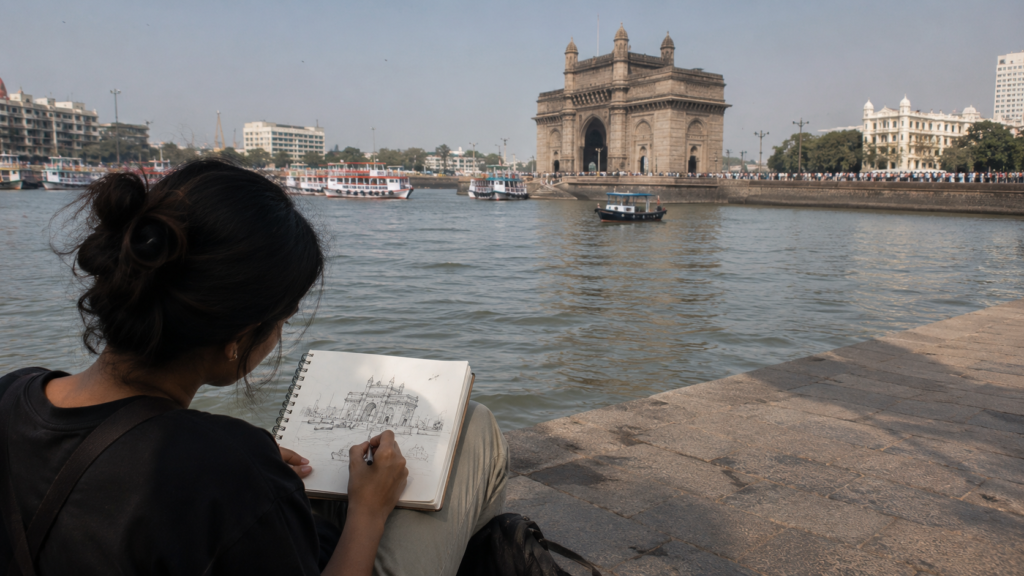
The Lost Art of Keeping a Sketchbook
Someone on the train is drawing the man across from him. Not well. Not for anyone. He’s not going to post it, frame it, or show it to a single person — and that’s exactly why it’s good.
That’s the sketchbook’s whole secret, and it’s the part we’ve quietly forgotten. Somewhere along the way, we decided that anything worth making is worth sharing — that if a drawing isn’t going to be seen, what’s the point of making it? The sketchbook exists to argue the opposite. It was never about the finished page. It’s a place to think with your hands — to get something wrong, scribble it out, try again, leave the mistake sitting right there next to the fix. No audience. No caption. No “final version.” Just you, slowly working out how to see.
And it doesn’t have to be drawings, either. Flip through anyone’s real sketchbook and you’ll find half-finished sketches next to scribbled notes, a torn ticket stub glued in, a paragraph about nothing in particular. It’s less a portfolio and more a container for everything that doesn’t have anywhere else to go — image, text, and half-formed thought, all sitting on the same page without needing to justify themselves.
That’s a strange kind of freedom, if you think about it. Almost nothing else in a creative practice is allowed to be just for you. Every other version of “making something” today comes with the quiet expectation of an audience — a post, a portfolio piece, a client deliverable. The sketchbook is one of the last places where the work doesn’t have to perform. It just has to exist.
It doesn’t ask for much, either. No studio, no setup — it fits in a bag, a back pocket, the empty seat next to you on the bus. That portability is exactly why it survives as a habit long after other, heavier creative rituals get abandoned. You don’t need permission or preparation to open it. You just need five spare minutes and something in front of you worth looking at.
And that act of looking is the real engine here. Drawing something in front of you — right there, right then — trains your eye in a way that photographing it never will. A photo remembers for you, which means you don’t have to. A sketch does the opposite: it makes you stay, notice the actual shape of a jawline or the way light falls across a table, and translate it, however roughly, with your own hand. That translation — clumsy as it often is — is where real observation gets built. It’s a slower kind of attention, and it’s rare enough now that it’s almost its own skill.
At Artiste 360, we still ask students to keep one, and not because it has to look good. A sketchbook shows how someone thinks — the false starts, the things they noticed, the ideas they abandoned halfway through — which tells a mentor or an admissions reviewer far more than a polished final piece ever could. It’s less a product and more a paper trail of attention.
But none of this requires you to be a student, or to call yourself an artist. It just asks you to be willing to sit still for five minutes and actually notice something, instead of photographing it and walking off.
If any of this has you wanting to start one, a few questions are worth sitting with: What actually goes on the first page? How do you turn it into something you reach for daily instead of forgetting in a drawer? And why do admissions reviewers light up when they see one? Good questions — ones we’ll get into soon.
The sketchbook isn’t lost because nobody draws anymore. It’s lost because we stopped letting ourselves make things that aren’t for anything.
Pick one up. Not to get good. Just to look again.