
What "Finding Your Style" Actually Means
Every art student waits for the same moment: pick up a pencil, and suddenly know your style. Clean, singular, unmistakably yours.
It doesn’t happen like that. Not for anyone.
The myth
Instagram grids and “10 years of art” progress posts have sold us a story: style is a destination you arrive at. One day you’re “figuring it out,” the next you’ve “made it.” Ask any working artist how they found their style, though, and watch them fumble — because there was no single moment. No lightning bolt.
What’s actually happening
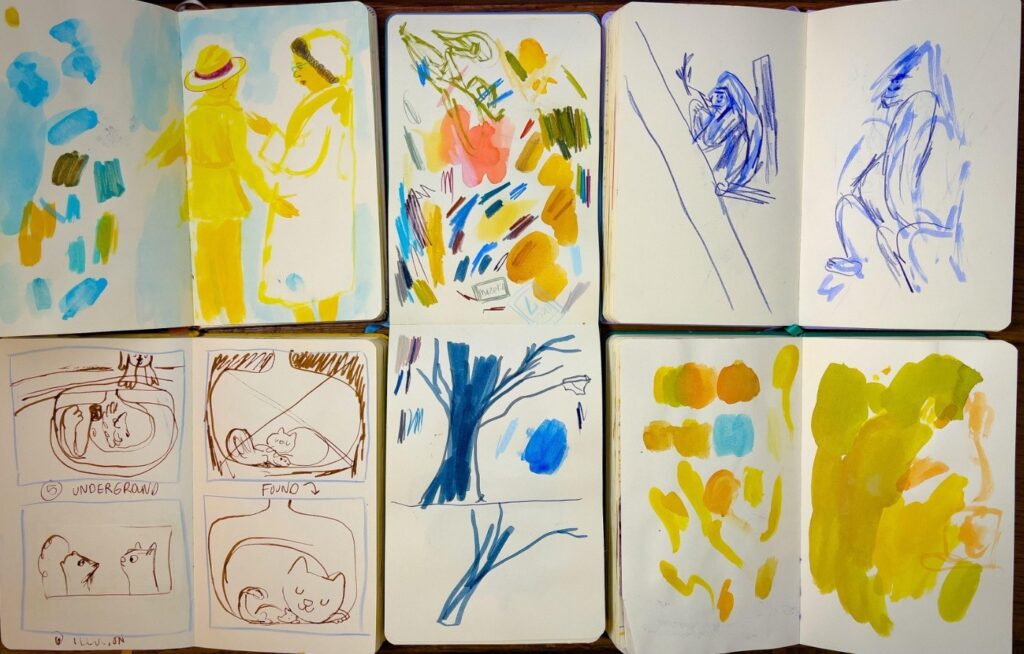
Style isn’t discovered. It’s the residue of hundreds of small decisions, repeated until they form a pattern — like handwriting. Nobody designs their handwriting; it just forms from habit, and a few years later it’s instantly recognizable as theirs. Your artistic style builds the same way, quietly, while you’re focused on just finishing the piece in front of you.
The colors you keep reaching for. The subjects you circle back to. The choices that feel honest versus the ones that feel performative. None of it looks like “style” in the moment. Zoom out a year later, and it is.
Proof, not just theory
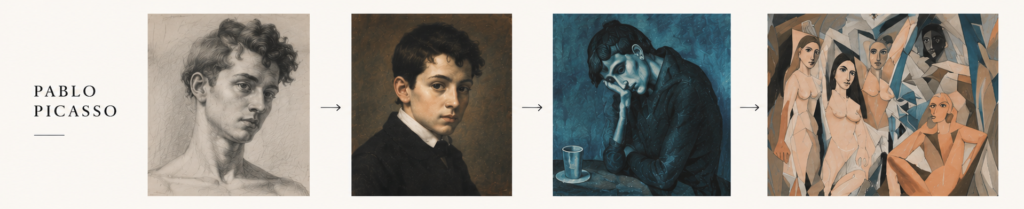
Nobody — not even the greats — started with a signature. Picasso spent his childhood being trained in strict, realistic figure drawing and oil painting under his father, a painting professor who wanted him classically skilled. By his teens, Picasso could reproduce academic realism convincingly. Cubism, the fractured, geometric style he’s actually known for, only showed up over a decade later — after years of shifting through different influences and emotional periods, including the somber, monochrome “Blue Period” that followed a personal loss. And even after Cubism made him famous, he didn’t stop moving — he went on to explore film and ceramics too, and you can trace the same visual instincts showing up across all of it. The style didn’t arrive first, and it didn’t stop evolving once it arrived. It emerged from everything he made before it, and kept reshaping itself with everything he made after.
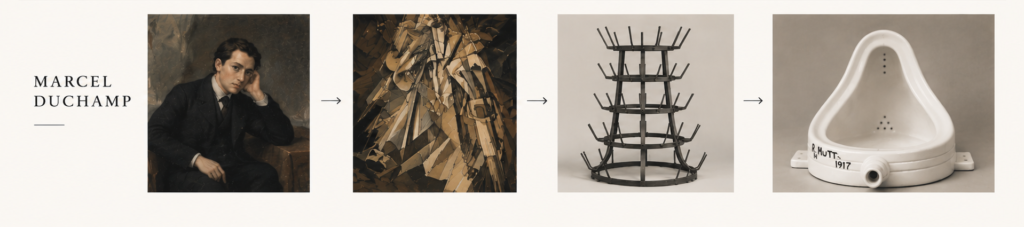
Marcel Duchamp’s path is even stranger, in the best way. He also trained academically — realistic drawings, cartoons, traditional salon paintings — the same starting point as everyone else. In 1912, he painted Nude Descending a Staircase, a Cubist piece so radical it scandalized audiences when it showed in New York the following year. At that point, most artists would have spent the rest of their career refining that one breakthrough style. Duchamp didn’t. He walked away from painting almost entirely.
Instead, he started taking ordinary, mass-produced objects — a bottle rack, a urinal — signing them, and calling them art. He named this idea the “readymade,” and it broke the art world’s basic assumption that art had to be made by hand at all. It’s a strange, almost anti-style move: instead of developing a recognizable technique, Duchamp’s “style” became the refusal to be pinned to one. That’s actually the whole point of the current MoMA retrospective on him — it lays out his career in order, academic training, then Cubism, then the readymades, and shows how each phase pushed against the one before it rather than polishing it. His “signature” wasn’t a look. It was a willingness to keep breaking his own pattern.
Neither of them found a style by looking for one. They found it by working long enough that the looking stopped mattering.
Why it matters
When style doesn’t arrive on schedule, students assume something’s wrong with them. What they’re missing is that every portfolio they envy is built on years of unseen, unglamorous trial and error. Style looks sudden from the outside. Never from the inside.
What to actually watch for
- What you keep doing without being told to
- Mistakes you don’t mind repeating (usually a preference in disguise)
- What feels like you, even if you can’t explain why
- What you consistently avoid
Keep documenting everything. Keep reflecting and experimenting. Let the pattern do the rest.
The Artiste 360 take
This is why we don’t push students toward a “signature look” early on. A rushed style is usually a borrowed one. We’d rather you make the work and let your pattern reveal itself — on your timeline, not anyone else’